
Who you are engaging
Four decades running communications for contested fights, the person who built the AI system this practice runs on, and the one clients call when they need a straight answer about what will not work.
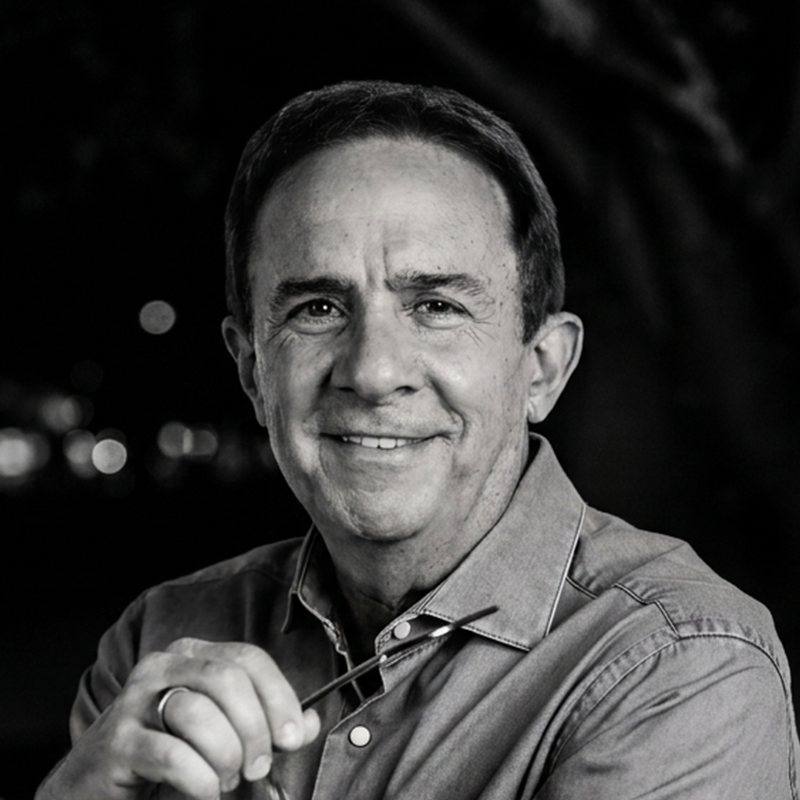
Steve Sanford trained as a mechanical engineer at Old Dominion University and has been writing code since Fortran on punch cards. He has spent four decades building companies across advertising, production, television, film, digital advocacy, regulatory campaigns, live Unreal Engine broadcasting, and AI. The specialty through all of it is high-stakes communications, in the United States and internationally: situations where the audience is not neutral, the other side is well funded, and being approximately right in public is the same as being wrong. Along the way he has produced more than 3,000 commercials for consumer brands.
In the 1990s he told the people building Broadcast.com that streaming would overtake traditional broadcast. It was not a popular position at the time. He was among the first to put streaming media and live television together, producing nightly simulcasts of Treasures in Your Home for PAX Television across two seasons, shot at CBN Studios in Virginia Beach and at Lifetime Studios. The instinct has not changed since: find the emerging application of a technology, then turn it into something that can actually be sold. “It is not about being first,” he says. “It is seeing what others do not see yet and bringing it to reality.”
The work since has been global strategic communications for regulatory fights and M&A, alongside turnaround CEO roles at venture-backed firms. In parallel, production at the high end: Unreal Engine green-screen studios and human digital twins at scale. A show he produced, Love and Respect with Killer Mike for PBS, took a Southeast Emmy in Interview and Discussion, Long Form. It was shot on multi-camera studios through the pandemic, at a point when most productions of its kind had simply stopped. It got finished because he rebuilt how it was made rather than waiting for the old way to come back. The agency craft and the strategy sit in the same person, which is unusual, and it is why a recommendation and the creative that carries it never have to survive a handoff.
That period is also the one that ended the business as it was. The pandemic took the client base with it, the way it took a lot of profitable companies, and none of it turned on a bad call. What came out the other side was built differently on purpose, and pivoting through a shock that removes the old model is the most transferable thing on this page.
The AI credential is an operating one rather than a point of view. He is co-founder of Simulus AI and Contero AI, a content platform that grounds its work in cited research and then runs adversarial agents against its own output to catch what the creative agents got wrong or invented. It serves paying businesses every day. He runs AI across every part of his own companies, roughly ninety percent of anything automatable, which is what leaves full attention for the client problem. His position on the technology is unsentimental: AI is not the problem, and it is not the answer either. It is a tool, and it fails the moment nobody is on it. He builds applications with it rather than theory or how-to videos, and the distance between talking about AI and running it at scale is most of what he gets called about.
A fair amount of the work is therefore advisory rather than executional. A company running twenty AI initiatives with no way to tell which three are real does not need another vendor. It needs somebody who has built enough of them to say which ones will not survive contact with production, and to say it while the money is still unspent. Killing sixteen of twenty is an unpopular answer and usually the correct one, and it is the same judgment a contested issue asks for, applied in a smaller room.
The verification architecture this practice sells is not a diagram. It is the thing keeping that platform honest right now, and the research system behind the exhibits on this site is one he wrote.
Track record
What is behind the work.
- Global campaigns
- Winning regulatory and government-affairs fights at global scale, usually behind a firm whose name is on the engagement.
- Regulatory and M&A
- Global strategic communications for regulatory fights and M&A. Turnaround CEO for venture-backed firms.
- Four decades
- Mechanical engineering at Old Dominion, and writing code since Fortran on punch cards. Advertising, production, film, digital advocacy, and now AI. Bet on streaming before most people had heard the word. Early, not wrong.
- Production at the high end
- Built Unreal Engine green-screen studios. More than 3,000 commercials, human digital twins at scale, and a Southeast Emmy for a PBS interview series produced through the pandemic, when most productions like it had stopped.
- Operating AI, not theorising about it
- Co-founder of Simulus AI and Contero AI, a production platform serving paying businesses every day, not a demo. It grounds its work in cited research, then runs adversarial agents against its own output to catch what the creative agents got wrong or invented. About ninety percent of anything automatable runs on AI here, which is what leaves full attention for the client problem. The advice clients buy comes out of operating it rather than out of watching the category.
Human Prompted. Human Approved.™ and Bringing Humanity to AI®.
That is the mission behind every company he runs.
One principal. Not a headcount.
What you engage is the judgment, and a system built to make it hold at speed. Where an engagement needs more hands than that, we say so before it starts rather than after.