
Capabilities
Intelligence, production, activation. And the AI layer that runs all three.
The first three are sequential and can be bought separately. The fourth is what makes them run at a speed the traditional process cannot match. The judgment that decides what to point them at is available on its own, without any of the rest. None of it is specific to one issue, because the issues change and the capability does not.
Intelligence and strategy
The strategy, and the evidence underneath it that survives a hostile read.
Opposition landscape, constituency mapping, message and claim testing, and a hard read on what is actually true and citable. Then the strategy that follows from it, because whoever holds the verified data should be the one shaping the argument. Most campaigns discover their weakest claim when the other side finds it. We find it first, in week one, and either source it properly or take it out of the argument.
What it delivers
- The strategic recommendation, and the data it rests on
- Constituency and stakeholder mapping by market
- Opposition argument inventory with the strongest version of each
- Claim and evidence audit: what survives scrutiny, what does not
- Message testing against the audiences that decide the outcome
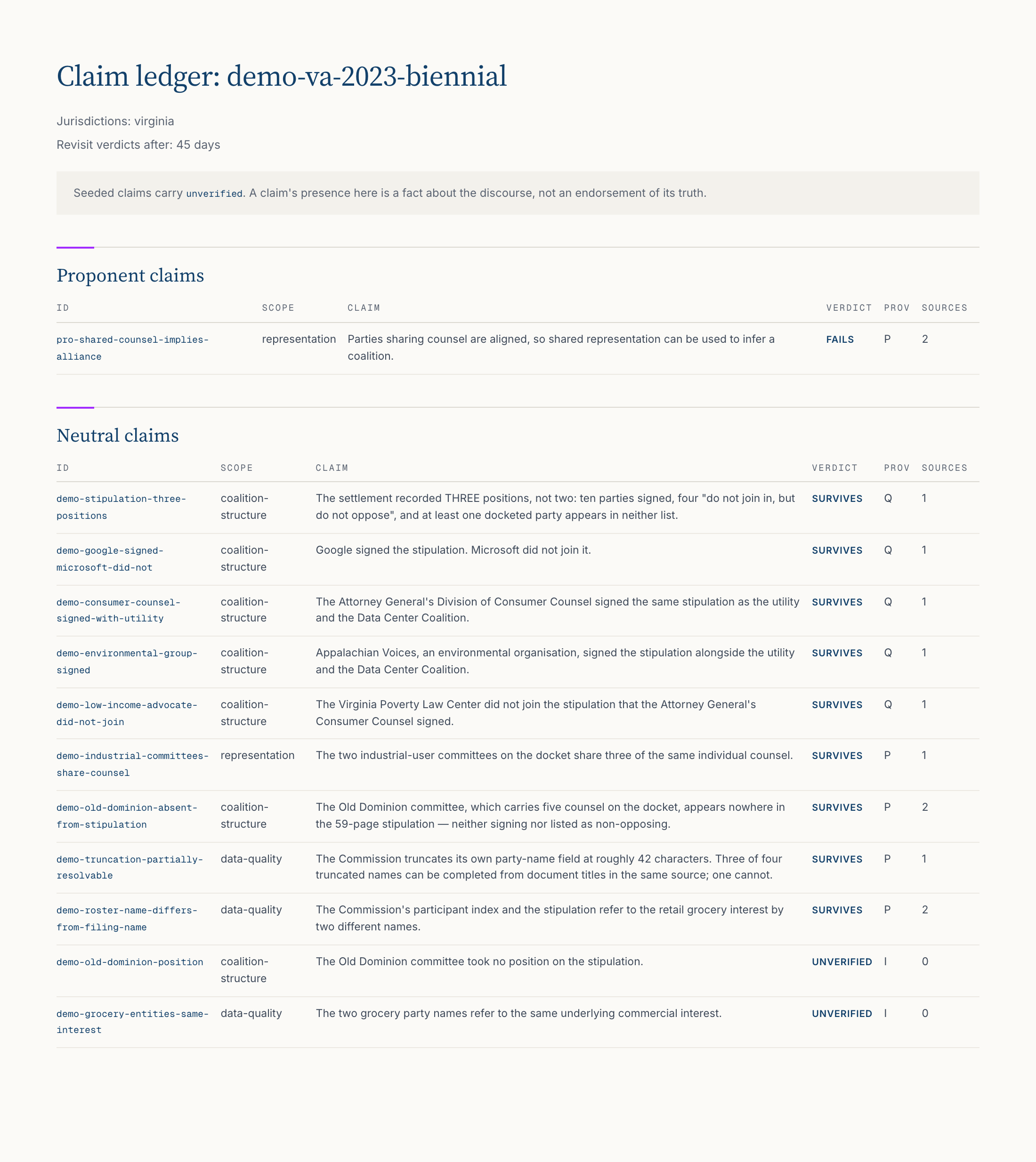
What a claim audit returns
FORMAT SAMPLE · NOT A CLIENT RECORD
- Cleared
The program serves [N] households statewide.
Traces to the administering agency’s own published count. Cite the agency record rather than the coverage of it.
- Common ground
Demand in this category is growing faster than the last plan assumed.
Asserted in filings on both sides. Nobody is going to contest it, which makes it the strongest ground in the argument and the most underused.
- Contested
Existing customers are held harmless.
Survives only with the qualifier the underlying document actually carries. Stated flat, it is refutable from the same document you are citing.
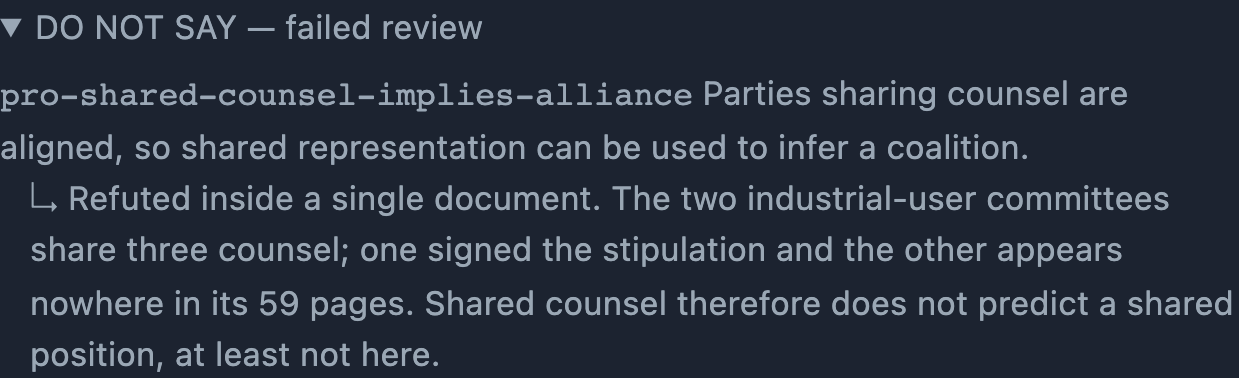
- Do not say
The comparable program created [N] permanent jobs.
The figure traces to a trade summary of a study that does not contain it. Struck in week one rather than in a hearing.
Production
Content at volume where the review scales with the output instead of falling behind it.
Localized, audience-specific, channel-native content produced at a rate that traditional agency process cannot reach, with every factual claim carrying a source. The tenth market costs us almost nothing and costs an agency the same as the first. That gap is the whole economic argument.
What it delivers
- Market-by-market localization without rewriting from scratch
- Full channel coverage: long form, social, email, video script
- Every statistic and factual claim traceable to a source
- Human approval on the record before anything ships
Cost of each additional market
ILLUSTRATIVE SHAPE · NOT MEASURED DATA
Traditional agency process
Market 10 costs what market 1 did
This operating layer
Built once, localized after
Activation
Persuading the people who actually decide, and proving what it did.
Earned media and press strategy, paid support, and targeted social aimed at the specific constituency that decides the outcome, whether that is a regulator, a council, a legislative audience or a neighbourhood. Reach is table stakes. Two things separate this: the argument reaching each audience is the one built for them rather than the national message reheated, and the record you can produce afterward holds up in a hearing, an investigation or a board review.
What it delivers
- Earned, paid and targeted social against a named constituency
- The argument localized per audience, not one message everywhere
- Disclosure handled by design rather than retrofitted
- Reporting built for scrutiny, not just for dashboards
- A complete record of what ran, where, and sourced to what
The AI operating layer
The layer underneath the first three, and the judgment to run it.
The agent workflows, research systems and verification gates that make the first three run at speed without losing the thread. This is the part that is not rentable. It is also the same capability sold directly to companies that want it inside their own operation rather than delivered as a service.
What it delivers
- Purpose-built agent workflows per engagement
- Adversarial agents run against our own output, not only against yours
- Verification gates that fail closed rather than fail quietly
- A research corpus that compounds across engagements
- An independent read where the answer is that an initiative should stop
- Direct licensing where a client wants the capability in house
How it starts
The diagnostic comes first.
Most engagements open with a fixed-price, fixed-scope diagnostic that sits inside capability one. It maps the constituency, inventories the opposition argument at its strongest, and audits which of your existing claims hold up under hostile scrutiny. Where the ask is narrower than that, a scoped advisory read is priced on its own and skips straight to the question you actually came with.
You get the good, the bad and the ugly, and you get a recommendation with it. We do not arrive with a white paper and a list of things to consider. We arrive with a point of view about how the issue is won, and the data underneath it, so the first conversation is an argument about the strategy rather than a briefing on the background.
You keep the document either way. If the diagnostic says the argument is weaker than the plan assumes, that is the most valuable thing we can tell you, and it is better to hear it in week one than in a hearing.
The diagnostic
From $25,000, fixed scope.
Priced as a deliverable rather than as a retainer, because it is one. You keep the document, and for some clients it is the entire engagement.